Also see an excellent article called
What is a Group? on Infed.org
[T]here have been numerous philosophical and theoretical influences on the development of social group work. Chief amongst these influences are the ethics of Judeo-Christian religions; the settlement house movement’s charitable and humanitarian efforts; theories eminent in progressive education, especially those of
John Dewey (1910); sociological theories about the nature of the relationship between man and society, i.e. Mead (1934); the democratic ethic articulated by early social philosophers; the psychoanalytic theories of Rank and Freud; the practice wisdom, theory building, educational and research efforts of early social group workers (Alissi, 1980; Kaiser, 1958; Wilson, 1976). Early theoretical, research and practice efforts of Grace Coyle (1930, 1935, 1937, 1947, 1948), Wilber Newstetter (1935), and Neva Boyd (1935) paved the way for the advancement and development of social group work.
Grace Coyle presented an early theoretical framework for social group work articulating the need for a democratic value base (Coyle, 1935), identifying the role of the worker as a group builder (Coyle, 1937) and noting the benefits of ‘esprit de corps’ or group morale (Coyle, 1930). As the editor of several small group research compendiums Hare (1976) would later point out, “many of her insights about group process were ahead of her time” (p. 388).
The work of Vinter and Schwartz and their respective associates would dominate the group work scene for much of this decade and the next (Galinsky & Schopler, 1974). In Vinter’s approach (1967) the treatment group is thought of as a small social system “whose influences can be planfully guided to modify client behavior” (p. 4). In this approach the worker takes a central position in providing treatment, interventions are planned, group process is highly structured, and great emphasis is given to outcome evaluation and research (Vinter, 1967; Garvin, 1987; Galinsky & Schopler, 1974). Schwartz (1961) proposed his vision of the small group as an enterprise in mutual aid.
In 1965 Bernstein and colleagues introduced another social group work practice theory (Bernstein, 1978; Lowy, 1978; Garland, Kolodney & Jones, 1978). The centerpiece of the edited collection was a developmental stage model, known as the Boston Model, which presented a framework for understanding how groups navigate degrees of emotional closeness over time (Bernstein, 1978; Garland, Kolodney & Jones, 1978). In 1966 Papell and Rothman (1966) presented a typology of social group work that included the social goals model (in the tradition of Coyle), the remedial model (as developed by Vinter) and the reciprocal model (as articulated by Schwartz). In 1968 Middleman (1968) made a seminal contribution in articulating an approach to group work practice that utilized non-verbal activities. In 1976 Roberts and Northen presented a collection of ten group work practice theories (Roberts & Northen, 1976) further illustrating the diversity of approaches to group practice.
The mutual aid model
The Mutual Aid Model of group work practice (Gitterman, 2004) has its roots in the practice theory proposed by William Schwartz (1961) which was introduced in the article, “The Social Worker in the Group”. Schwartz (1961) envisioned the group as an
“enterprise in mutual aid, an alliance of individuals who need each other in varying degrees, to work on certain common problems” (p.266).
Schwartz elaborated:
“the fact is that this is a helping system in which clients need each other as well as the worker. This need to use each other, to create not one but many helping relationships, is a vital ingredient of the group process and constitutes a need over and above the specific tasks for which the group was formed” (1961, p. 266).
While referred to as social group work (Papell & Rothman,1966), Schwartz preferred to think of this model as social work with groups (Schwartz, 1976). Schwartz (1976) regarded this approach as resonant with the demands of a variety of group types including, natural and formed; therapeutic and task; open and closed; and voluntary and mandatory. Schwartz (1961, 1964) initially thought of this approach as an organic systems model (as he viewed the group as an organic whole) later to refer to it as the mediating model and then the interactionist model (Schwartz, 1977). The model initially proposed by Schwartz has been further developed most notably by Lawrence Shulman and Alex Gitterman, who have since referred to this model as the Mutual Aid Model (Gitterman, 2004, 2005; Shulman, 1979, 1992, 1999, 2005b).
[edit]Cognitive-behavioral group work
The Cognitive-Behavioral Group Work Model is recognized as influential contemporary group work practice approach (Rose, 2004). The approach suggested by Rose (1989, 2004) integrates cognitive and behavioral interventions with small group strategies. While primacy is not placed on establishing the group as a mutual aid system in quite the same way as with the Mutual Aid Model, Rose (2004) suggests the worker promote group discussion and member interaction. Furthermore, drawing upon Yalom’s Therapeutic Factor construct Rose (2004) points out the benefits of universality, altruism, and group cohesion as well as mutual reinforcement, factors which are conceptually resonant with mutual aid.
Group work with mandated members
The involuntary client can be understood as someone who is pressured by some external source to seek social services (Rooney and Chovanec, 2004). Mandated involuntary clients are pressured to seek services as a result of the legal system (Rooney & Chovanec, 2004). Rooney and Chovanec (2004) identify reactance theory as an explanatory framework for the attitude and behaviors of the involuntary client and the mandated involuntary client. Reactance theory suggests that as a person is pressured to relinquish certain behaviors as a result of treatment efforts they experience reactance, “a motivational drive to restore those free behaviors” (Rooney & Chovanec, 2004, p. 213). Rooney and Chovanec (2004) suggest an approach that draws upon the
Transtheoretical (Stages of Change) Model and Motivational Interviewing in identifying strategies for engaging involuntary clients in the group process.
Tom Caplan (2008) suggests the Needs ABC Model.
What is A Group: Defining Groupwork
Groups may be defined in many ways, indeed providing an absolute definition of a group, as with much of the theory around group work, is highly problematic and contestable. However for the purposes of discussing groupwork within a context of working with young people we may define a group as a small gathering of young people. Group work may simplistically be described as the study and application of the processes and outcomes experienced when a small group comes together.
Konopka (1963) defines groupwork as a method of social work that is utilised in order to `help individuals to enhance their social functioning through purposeful group experiences, and to cope more effectively with their personal, group or community problems`. This definition shows a tradition within groupwork of helping individuals with problems. Brown provides a modernised and more comprehensive definition of group work (1994, p.8). He states that `groupwork provides a context in which individuals help each other; it is a method of helping groups as well as helping individuals; and it can enable individuals and groups to influence and change personal, group, organisational and community problems` (original emphasis). He goes on to distinguish between `relatively small and neighbourhood centred` work and `macro, societal and political approaches` within community work, explaining that only the former may be properly classified as groupwork.
Thus the role of groupwork can be seen as one which places emphasis on sharing of thoughts, ideas, problems and activities.
Stages of Group Development
Groups, like individuals are each unique with their own experiences and expectations. However many commentators studying group development and dynamics have recognised that group development, as a generalisation, is more predictable than individual behaviour. Thus many theories of group stage development have been cultivated, some linear, others more cyclical, and it must be stressed that no definitive model of group stage development exists.
Two of the most useful theories of group stage development are those discussed by Tuckman (1965), and Rogers paper on encounter groups (1967). These models, like others (for example Heap, 1977) propose that as groups develop and change they pass through stages which may be conceptualised. Tuckman’s model has been used extensively within youth work theory and practice and is an excellent model for attempting to analyse individual and group behaviour. A brief synopsis of each stage is outlined below, with examples from personal practice.
Stage 1: Forming
The first stage of this group process is joining, referred to as engagement by Rogers. This phase involves significant testing, and trial and error. Initial concerns about openness and support within the group are manifested by a lack of cohesion and a difficulty in sharing thoughts, feelings and experiences with each other. An internal appraisal of group value and how each individual belongs to the group are key features of this stage. Anxiety, isolation, inadequacy and frustration are common emotions felt by group members at this early stage in the life of a group, as well as being emotionally threatened by members of the group who are perceived to be stronger or better. Thus the group seeks to create a comfort zone in which individuals are not keen to upset the status quo for fear of alienation.
Oppressive behaviour is least likely within the formation stage of a group as individuals generally look to create a comfort zone and do not wish to rock the boat. Often frustrations will be built upon between individuals who disagree strongly, but this will generally not surface until storming begins.
A knowledge and understanding of the feelings and emotions felt by group members in this stage is helpful, if not essential, to the effective structuring of a programme to work towards the desired outcome for the group. For example both the YAM and PTV groups I had experience with were set up to encourage social interaction and personal development. Having an awareness of group stage theory enabled my colleagues and myself to structure the early encounters for the groups to be;
a) fun and enjoyable – to encourage continued attendance;
b) relaxed - offering the promotion of effective communication and allowing members to get to know each other a little whilst gaining in confidence and trust.
To this end ice breakers, introduction and communication exercisers such as those provided by Brandes and Phillips (1979), Bond (1986), Leech and Wooster (1986) and Dearling and Armstrong (1994) were used. As Dynes describes `[games] stimulate the imagination, make people resourceful and help develop social ability and co-operation` (Dynes, 1990).
Stage 2: Storming
This stage sees group members begin to confront each other as they begin to vie for roles within the group that will help them to belong and to feel valued. Thus as members begin to assert their individual personalities, the comfort of the forming stage begins to come under siege. Members experience personal, intra and inter group conflicts. Aggression and resentment may manifest in this stage and thus if strong personalities emerge and leadership is unresponsive to group and individual needs, the situation may become destructive to the group’ s development. Indeed there is a high potential for individuals to abandon the group during this stage, as for some the pressures created by the group may become too much of a strain.
The potential for oppressive behaviour is strong within the storming phase as group members vie for preferred roles and release frustrations built within the forming period. This personal oppression should be discouraged whilst it is understood that a degree of conflict is necessary if the group is to further develop.
In the YAM group this stage was represented by a rebellious streak within the young people and much of the storming was directed towards the adult leaders. Boundaries within the group were tested as the group explored how far they would be allowed to go and what they could get away with. One or two individuals in turn challenged this behaviour as they felt it was unfair and could jeopardize future activities.
The PTV group’s storming phase was altogether different. Two of the group with strong personalities began to vie for intra-group leadership. Each used their own abilities to strengthen their claim to lead the group, whilst also sabotaging and undermining the other’s efforts in an attempt to usurp the leadership role. This situation caused a degree of infighting and at one point created two sub-groups, one following each of the `pretender` leaders.
It is important to be aware that conflict will take place within all groups, and if handled well this conflict can produce benefits for the group in terms of development, objective and task setting, and ultimate outcome. Thus conflict is not inherently something to be feared or avoided.
Stage 3: Norming
During this stage the group begin to work more constructively together towards formal identified or informal tasks. Roles begin to develop and be allocated within the group and although these may be accepted, some members may not be comfortable with the role or roles which the have been allocated. During this stage sub-groups are likely to form in order that a supportive environment is once more created. Acceptable and unacceptable behaviours within the group are created and reinforced and thus the `norms` for this group become fabricated.
The storming and norming phases of group development are inextricably linked, as it is often through the storming and challenging that acceptable group norms become set.
It is important that a youth worker works hard during this stage to ensure oppression against individuals within the group do not become the acceptable norm, as then all group members will oppress these individuals. Thus, individual oppressions must be challenged and emphasis placed on challenging attitudes and opinions but not group members.
The YAM group settled into group norms quite quickly, however some of the roles that were adopted were challenged by the co-leaders as they were seen to be obstructive to the group and individual’s objectives. One young person (J.) who was often badly behaved at school, was previously known to other group members. As these young people expected poor behaviour from J. this was the role which he adopted. This was challenged within the group context and it was pointed out that alternatives to this behaviour were available.
Stage 4: Performing
This stage sees the group performing effectively with defined roles, in fact at this stage it could be said that the group has transformed into a team. It is now that decisions may be positively challenged or reinforced by the group as a whole. The discomfort of the storming and norming phases has been overcome and the group has a general feeling of unity. This is the best stage for a group to complete tasks, assuming that task, rather than process and individuals, are the focus of the group.
An excellent example of performing within the PTV group came during a residential week. One of the group (A.) admitted to a fear of heights and thus did not want to take part in an abseiling exercise. The whole group supported this decision but offered encouragement and support in order to promote participation. One individual (M.) spent time and energy showing leadership and helped A. to overcome his fears. A. took part in the abseil, being assisted by M. and encouraged by the whole group.
Potential exists within this stage for oppression to begin if one or more group members does not appear to fit in with the group’s view of its task, or is not performing as effectively as expected. Again it is important to challenge this if it occurs and to show how each member can benefit the group, through achievement of task, leadership, reviewing, moving on, or by monitoring the groups process.
Stage 5: Mourning
The final stage in the life of a group ultimately is its termination. Though often overlooked, this stage in group development is equally important to positive outcomes. The ending of a group can be a very unhappy and distressing time for some members, as they may feel some extent of dependency on the group. Garlandet al. describe some of the typical responses to the ending phase as:
· Denial – `forgetting` the time of the groups termination.
· Regression – reverting to a less independent state of functioning.
· Need expression – in the hope the group will continue.
· Recapitulation – detailed recall of past experiences within the group.
· Evaluation – detailed discussion on the value of the group experience.
· Flight – destructive denial of any positive benefit of the group, or a positive disengagement towards other interests.
Potential exists within this stage for members to be oppressed as scapegoats, that is blamed or at fault for the ending of the group. This can be minimised by constant focusing and refocusing on group end points and staged celebrations of group achievements.
With the PTV group it was relatively easy to develop strategies to minimise the effects of the groups termination. The group’s life span was structured to a tight time-scale and end point from the outset. This was reinforced by getting the group to maintain a counting down chart which was marked off each day. The end of the group was marked by a large presentation to which friends and relatives were invited. The presentation marked a clear ending for the group from day one, whilst also serving as a celebration of all the groups achievements during its existence. Thus the end did not come as a `surprise`, and was something to look forward to.
As we have seen the value of a theoretical understanding of conceptualising this group stage theory in youth work and other helping professions, lies in enabling group workers to `tune into the group’s processes and respond appropriately` (Preston-Shoot, 1987).
Group Leadership (and Types)
Effective groups should promote the value of all of its constituent members. One of the keys to establishing this end is competent leadership.
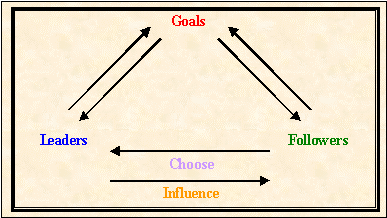 Leadership can be and has been defined in many ways. It is seen as ` the act of commanding and directing, the actions of leaders, the process by which groups achieve their goals, the antithesis of followership` (Sessoms and Stevenson, 1981, p. 5). Leadership can be seen as the act of `moving people towards goal achievement`, and may be viewed as an interaction between leaders, followers and goals (see Fig. 1, above), thus it may be described as a process (Sessoms andStevenson, ibid). Fig. 1. - Source: Sessoms and Stevenson (1981)
So `In a broad sense, leadership may be described as influence` (Barker et al, 1979, p. 224), thus the individual who will often be seen as the leader of a youth group, that is the adult, often may in fact not be the most influential member of the group.
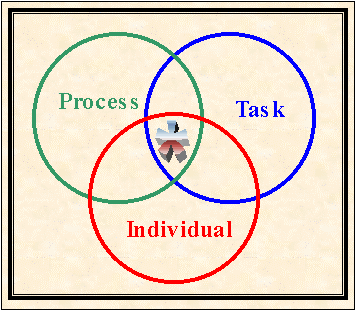 Effective leadership depends on the balancing of the three variables in diagram Fig. 2. (left), thus the groups task, individual needs and group maintenance must all be considered.
Fig. 2. - Source: Adapted from John Adair (1988) Effective Leadership
Fundamentally within youth work we must recognise the `possibility of all members contributing to the process by which groups seek and achieve goals` (Barker et al, 1979, p. 226-229). Thus leadership is a dynamic variable and any `person who performs actions which move a group toward its goal and/or maintain the group more frequently and more effectively than other group members` may be identified as group leaders (Barker et al, 1979, ibid.).
Leadership is often described within a context of three differing styles, laissez faire, democratic and autocratic (or authoritarian).
Simplistically the three styles can be described as;
Laissez faire – letting members do pretty much as they please without the leader offering judgement on other members decisions. This works best when a well functioning group, i.e. one than may be in a performing phase, is working towards a well defined task. This method is exceptionally difficult if more than a handful of group members are present and is often used within sub-groups developed to perform specific sub-tasks. For example the PTV team would use this style for brainstorming specific ideas for projects, as the non-judgemental attitude facilitated more group responses.
Democratic – consultation and discussion takes place before decisions are made. This allows group members to have their say but does not guarantee that these feelings will be acted upon. This style is an ideal method of leadership within youth work as the group is more likely to contribute to the decision making process and also the group is more likely to buy-in to decisions which are made. Again this style works best with smaller groups, the larger the group the longer the decision making processes will tend to become. It is often preferable to separate a very large group into sub-groups to ensure all have a chance to input into decision making and then reconvene all group members into a plenary session where all ideas can be fed back and shared, resulting in an ultimate group decision. This style was used within the PTV group in order to achieve a shared sense of belonging within the group and to get all the members to `buy-in` to completing the tasks in hand.
Autocratic or authoritarian – one leader is the sole person involved in making decisions within the group, the information is passed on to the group rather than options being discussed openly. This is a style that I have personally seldom used as it is not ideal for achieving the educational aims of youth work. However I am aware that very large groups may find an autocratic leader can speed up a decision making process. This can be important when issues such as the group’s physical safety are involved, for example if a group is on expedition on the side of a mountain and the weather becomes rough, it may become necessary to enforce a quick decision to retreat, to ensure group safety. The process of this decision making can then be evaluated and debated once the group is in a safe setting.
Roles within Groups
Each individual within a group has a role to play in the development of that group to a greater or lesser extent. Through observation, understanding of difference, awareness of personal resources and effectivecommunication (Douglas, 1995), each member may affect group processes and individual emotions. Roles develop within groups both through formal appointment and because of the personal characteristics and interpersonal relationships that develop between members. Roles which develop can be constructive and support the group and its members in achieving its goals, or can be destructive and work against the overall group aims. Individuals within the group can develop several roles and at times these may conflict. For example a PTV member who was designated as leader for a specific task, also played a clown and was fond of practical jokes. The fooling around led to a lack of trust from other group members creating a conflict with the leadership role.
As the group begins to develop an understanding of four things can be observed:
Observation: the way we behave is based upon what we observe of ourselves, and what we make of others and their reactions to us.
Differences: personally and socially generated; the effects they have on behaviour and understanding.
Resources: frequently stemming from difference but are the source of potential power for a group and an individual.
Communication: considered to be natural but subject to many barriers that remain largely unknown unless a conscious effort is made to find them:
(Douglas, 1995, p. 80-97)
Through supportive roles, groups may play a part in reducing oppression generated externally to the group. Groupwork can be used as a medium for oppressed groups to `help these groups adjust in society`, and moreover to help society to adjust towards these groups. This can be achieved by `individual rehabilitation` in which we can `help individuals to adjust to social life and manage … tension … gain confidence, high self esteem`, and in `getting and keeping employment etc.`. `Societal or community rehabilitation` involves `helping the society to have meaningful contact` with individuals and groups which are discriminated against and oppressed (Osei-Hwedie, Mwansa, and Mufune, 1990, p. 188).
Preston-Shoot describes groupwork creating a `sense of belonging and mutual identity` encouraging `the formation of relationships which foster mutual identification and influence`, thus feelings of isolation and singularity with issues of difference and oppression may be reduced. Also, the group may be encouraged to use its internal resources to move towards individual or group `problem-resolution`, reducing feelings of helplessness, building self worth, and discouraging worker dependency (Preston-Shoot, 1987, p. 6-28). Smith concurs with this view of the suitability of groupwork, stating `Groups are obvious sites of interaction and within them a sense of connectedness or community with others can be fostered` (Smith, 1994, p.111). This `connectedness` is a valuable tool with which to challenge discrimination and oppression, for as Piven and Cloward argue, it is only when we act collectively that change can begin (Piven and Cloward, 1993).
Conclusion: Group Work – Double Edged Sword?
To state that group work is not an exact science is something of an understatement. As we have seen, it is problematic to even define what is meant by a group as no absolute definition exists. Similarly most, if not all, concepts within group work theory can be, and are, contested.
Groups are extremely important in the lives of all individuals. Johnson and Johnson (1975, p1-2) state `many of our goals can be achieved only with the cooperation and coordination of others`.
However `the success of any group depends on the ability of its members to exchange ideas freely and to feel involved in the life and decisions of the group` (Massallay, 1990). All groups within youth work have goals, i.e. a future state of affairs. It is important that short term and long term goals are set realistically if the group is to develop and function effectively. These functions are achieved through the direction of leadership and the development of individual roles within each group.
