Showing posts with label happiness. Show all posts

Wednesday, February 5, 2014

Healthcare Reform is working as planned, with good reason, as it will reduce the (slave/forced) labor force by 2.5 million


 Health Care Law Projected to Cut the Labor Force

WASHINGTON — A Congressional Budget Office analysis released Tuesday predicted that the Affordable Care Act would shrink the work force by the equivalent of more than two million full-time positions.   NY Times 

No, CBO did not say Obamacare will kill 2 million jobs

The Fact Checker had to repeatedly explain that the Congressional Budget Office never said that the Affordable Care Act “killed” 800,000 jobs by 2021. Now, the CBO has released an updated estimate, nearly the triple the size of the earlier one: 2.3 million in 2021.   The Washington Post. FACT CHECKER: The Truth Behind the Rhetoric


Healthcare Reform is working as planned and it's fantastic news for our country and our people.  The CBO (congressional budget office) projects that 2.5 million full-time positions in the next ten years.

Because workers will CHOOSE NOT TO WORK FULL-TIME.

In my educated opinion, this is a totally healthy choice from a mental health and self-care perspective.  So many people feel forced to get and keep jobs that they don't want, are bad for them, and don't even need to be full-time positions.  Probably a third of full-time job hours are spent by employees not working, simply because they have to be there, it's a stable job, and they can't afford to leave the job because they need health care and so do their children and/or spouses.

That's one of the purposes of this reform measure, to reform the system away from this quid-pro-quo situation that is simply taken for granted now.  FT work means benefits and a salary, and that also lots of times means working over-time for no extra pay.  We want people to HAVE more choice so that they AREN'T tied to their jobs because they need healthcare and insurance!

Corporations and the power-brokers in Washington want you to have less choice and to keep you as a slave to their needs.  Opponents of the ACA, who derisively call it Obamacare (namely GOP Republicans) will spin this as bad for "business" and the economy and for people in general.

But, it's fantastic for everyone - individuals, families, children, for the job market, especially job seekers, and anyone who values being able to have control over their own lives.  Congratulations, Americans, we are finally doing what's right and best for us.  Let's keep it up!

Tuesday, December 11, 2012

News: ADHD Can Cause Lifelong Problems, Study Finds - US News and World Report

ADHD Can Cause Lifelong Problems, Study Finds


Attention-deficit/hyperactivity disorder that persists into adulthood may affect physical and mental health


If children with attention-deficit/hyperactivity disorder, or ADHD, continue to have the condition in adulthood, a new study suggests that they may face an array of physical and mental health issues.
The study, which spanned more than 30 years, found that people who had ADHD as teens and adults face a greater risk of stress, work problems, financial troubles, physical health issues and additional mental health issues, such as depression or antisocial personality disorder.  
They also had difficulty in terms of work and experienced a great deal of financial stress.  82 percent higher odds of having impaired physical health. They were also more than twice as likely to have another mental health problem
 The study included 551 children. Seventy-two of those children were diagnosed with ADHD in 1975 when they were between the ages of 14 and 16. The researchers followed up with the children as they grew, and the final of five outcome surveys was given at an average age of 37.

ADHD Study - US News and World Report 

Wednesday, April 25, 2012

Community Engagement Model Development plans

So, I want to spend some time learning about community engagement.  Since I began this final internship of my graduate education, this seems to be a huge part that's missing in community change efforts.  I want to know what I can learn from the research out there - what are well-researched methods? what are best evidence-based practices? what "should" we be using in our change projects? when is best to poll the community?  in the beginning, before we start, as a check-up on progress, to gain satisfaction rating on the job we're doing, in the end as an evaluative measure?  ALL OF THE ABOVE?  How can we partner with communities and their members, the people who are actually affected most by these changes, and the ones who probably know best (despite our best efforts at studying them)?  How can we act as community members' consultants, instead of what usually happens that we end up doing things to them?

Below is a mind map of some of the thoughts I have on the issue, and where I want to go with these ideas.  Ultimately, I'd like to continue the work that I'm doing at my internship -- collaborating with other community planning staff on unique ways that we can do this as social scientists, ways that including use of the many tools available to us on the Internet, and ways that make partnering with community representatives and stakeholders as painless, inexpensive, and rewarding as possible.

I don't know if anyone will read this, but I'm looking for people to partner with to work on this project.  I have an idea to start us off with that I believe would be effective. 

If you think you might be interested, please let me know.  Eventually, I want to publish a paper about the development of the model and the data collected about its effectiveness during testing.  At the least, I want to publish it in the "grey literature" (websites and other self-publishing media).

Saturday, March 10, 2012

Lifehacker: Breakfast in a mug in one minute (and why are we only giving it ONE minute?)

Make Breakfast in a Mug in Just One MinuteWell, breakfast IS the most important meal of the day.  I think so many of us just don’t have the time, or maybe we aren’t hungry, yet?  I think caffeine in the coffee has a lot to do with suppressing the appetite when you get started with it early every morning.  I find that my appetite doesn’t come around until 10am after having coffee. Anyway, the evils of coffee and caffeine, no matter how good they taste, aren’t the point of this post.  The positive, that breakfast is important, healthy, and yes necessary, is the point. 

Here’s an article on Lifehacker.com that talks about how to do it quickly.  As mentioned, you can add any numbers of ingredients to spruce up the meal and make it even more healthy.  Getting something in your stomach in the mornings is putting you ahead of the game, anyway, though!

Interestingly, though, the comments part of the article is (as usual) one of the most interesting things about it,  There’s a debate about whether or not reducing breakfast to one minute means that we seriously need to consider how packed, filled, and fast-paced our lives has become.  This is what I am putting my money – we need reset our priorities when it comes down to needing tips like this, eh?  It’s not that we don’t want to do things that are quick and easy, but there’s something to be said for Quality of Life and taking our time with such essential things as our health and having healthy bodies and minds.

So, here’s my compromise:  I was a cook in the Army and have been cooking for 25 years.... I liked this idea enough to read the article, but the commenters are mostly right I think.  I don't seem to have time to eat in the mornings.  It does ONLY take two minutes to cook an egg in a pan and it tastes better.  Many here have mentioned cleaning the pan and how long that takes, but for my life it makes sense to simply put the pan back into the oven (with the spatula as well) so that you can take it out again the next day or the day after.  Wash it once a week, at most.  Either cast-iron, or non-stick, you're only talking about some oil left in the pan, which doesn't mean it's "dirty."  And, it doesn't go bad or make you sick.  So, that's even easier. 

As an after thought, I just want to add here that for my life, I want to be more healthy, eat the breakfast even if I’m not hungry – or, at least, change some things so that a normal hunger is what I wake up with!  so, maybe it’s time to prioritize things like rest, going to sleep earlier, trying to resist the natural inclination of a student to stay up later and later at night.  The morning is such a beautiful and peaceful time.  The night can be peaceful, too, so I vacillate between which is more peaceful.  The point is that I need and love peace and quiet.  I need to move to the woods :-)

Thursday, October 6, 2011

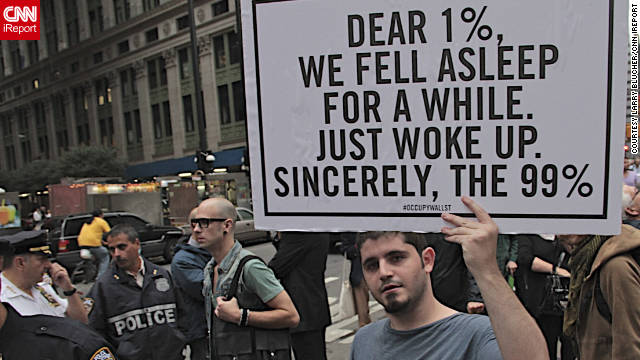
Occupy Wall Street: STOP Police Brutality Against Peaceful Protestors


Stand with Occupy Wall Street
Not a single banker has gone to jail for crimes that led to the financial meltdown. But now over 1,000 protesters have been arrested in the inspiring Occupy Wall Street protest in New York City. Tell Mayor Bloomberg and Police Commissioner Kelly: Respect the Occupy Wall Street protesters' constitutional right to peaceful assembly.
MSNBC on NYPD Police Brutality during Occupy Wall Street Lawrence O'donnell (video)
An excellent piece of main stream coverage on this past weekend


MSNBC Article: 
Who is occupying Wall Street? Not just your average Joe

          
October 6, 2011

Huffington Post: Occupy Wall Street Mass Arrest Resembles Infamous, Costly Police Tactic, Critics Say


MassEquality Statement In Support of Occupy Boston

 BOSTON, October 6, 2011—The LGBT community is disproportionately represented among those who are victims of the nation’s ongoing economic crisis. We are the un- and underemployed. We are the un- and underinsured. We are the homeless and under-housed. And we are disproportionately impacted by government-sanctioned discrimination and denial of resources and protections.
If any group understands the plight of the 99% given voice by Occupy Boston, it’s the Commonwealth’s LGBT 6.5%

A protester holds a sign at the Occupy Wall Street protest last weekend
www.cnn.com
October 5, 2011
The 19-day-old Occupy Wall Street movement continues to gain momentum with the Left, as Democratic politicians, progressive groups and unions are joining the cause.  Members of the Service Employees International Union, the Communications Workers' union, the New York AFL-CIO and the United Federation of Teachers joined today's big march on Wall Street.

 "We're down with these protesters. We support the notion that rich folk are not paying their fair share," said Transport Workers Union President John Samuelsen. "Our bus operators are not going to be pressed into service to arrest protesters anywhere."


October 5, 2011

Occupy Wall Street Police Baton Attack Protesters 


(video)
Again.  NYPD white shirt attacks reporters and protestors by wildly swinging a baton. The officer has been identified by Anonymous as Lt. Brian Connolly.


www.digitaljournal.com
Occupy Wall Street has progressed from a small undistinguished movement to a front runner of national emerging protests within 19 days. This movement against corrupt corporations and Wall Street has quickly gained momentum within Middle America.


September 29, 2011


Thumbnail
Video of Police Using a Knee to the Throat of Protestor


September 25, 2011
Cops turn Violent, NYPD drag girl across the street (video)
September 24, 2011
PEACEFUL FEMALE PROTESTORS PENNED IN THE STREET AND MACED by NYPD Deputy Inspector Anthony Bologna (video)

Thumbnail


Video :  Arrested for yelling at a police officer.  For shooting video.  Dragged from behind the police line.  For standing in the street.

Thumbnail
 Video: This man was flipped over by his arm and twisted then arrested - for talking to an officer.

Tuesday, July 12, 2011

Resiliency Discussion by Dr. Joan Borysenko with Cheryl Richardson

Listen and download the podcast here!

Listen to Special Guests | Cheryl Richardson: "Monthly Telegathering with Dr. Joan Borysenko November 30, 2009. The book is called It’s Not the End of the World: Developing Resilience in Times of Change. Hear the extraordinary story of how Joan found resilience after a family tragedy, and was able to shift gears and begin a whole new line of work that has helped thousands of people. And, learn how to develop this kind of powerful resilience, too!"

Dr. Borysenko points out that resilience research shows some components of resiliency come from the characteristics of:

1. Realism
  • Have you ever thought that maybe a pessimist is a disappointed optimist or idealist?
  • "Pessimist complain about the wind. Optimists expect the wind to change. Realists adjust the sails."
  • Optimists tend to possess very little resiliency.

2. Faith
An openness to live in the moment.

3. Creativity

Thursday, January 20, 2011

The evolution of body types (3)

Next time you're at the gym, ponder this: The look you may be going for wasn't always considered chic. The classic body type has evolved throughout the years.

And it likely won't be tomorrow.


Friday, April 16, 2010

NYT News: Aging and Gay, and Facing Prejudice in Twilight


Aging and Gay, and Facing Prejudice in Twilight

What should institutions do to help elderly, gay clients?

James Estrin/The New York Times

Even now, at 81 and with her memory beginning to fade, Gloria Donadello recalls her painful brush with bigotry at an assisted-living center in Santa Fe, N.M. Sitting with those she considered friends, “people were laughing and making certain kinds of comments, and I told them, ‘Please don’t do that, because I’m gay.’”

Jalna Perry of Boston said her guard was always up in nursing homes. 

The result of her outspokenness, Ms. Donadello said, was swift and merciless. “Everyone looked horrified,” she said. No longer included in conversation or welcome at meals, she plunged into depression. Medication did not help. With her emotional health deteriorating, Ms. Donadello moved into an adult community nearby that caters to gay men and lesbians.

So that is where Lisa Krinsky, the director of the L.G.B.T. Aging Project in Massachusetts, begins her “cultural competency” training sessions, including one last month at North Shore Elder Services in Danvers. 

In the last two years, Ms. Krinsky has trained more than 2,000 employees of agencies serving the elderly across Massachusetts. She presents them with common problems and nudges them toward solutions.  

“We need to be open and sensitive,” Ms. Krinsky said, “but not wrap them in a rainbow flag and make them march in a parade.”

Monday, April 12, 2010

SWB / Happiness : Variables Which Are Correlated refined

Based on DeNeve and Cooper's (1998). The happy personality: A meta-analyses of 137 personality traits and subjective well-being. Psychological Bulletin, 124, 197-229 findings:

The highest correlates with subjective well-being are:
  1. r=.30 Personality traits, namely trust, emotional stability (neuroticism?), desire for control, hardiness, locus of control-chance (believing events happen by chance), and tension (experiencing negative emotions).
  2. r=.29 Affiliation (wanting to relate to others)
  3. r=.29 Perceived Control
  4. r=-.27 Neuroticism
  5. r=.25 Internal Locus of Control (crediting or blaming self for events that happen)
  6. r=.23 Social Desirability (responding in a manner one believes will lead to approval from others)
  7. r=.20 Sociability (relating well with others)
  8. r=.20 Extraversion
From Lykken & Tellegran. (1996). Happiness is a stochastic phenomenon. American Psychological Society, 7(3), 186-189
  • Genetics also account for 80% of stable SWB

From Lucas, Richard E.; Fujita , Frank (2000). Factors influencing the relation between extraversion and pleasant affect.Journal of Personality and Social Psychology, Vol 79(6), Dec, 2000. pp. 1039-1056.
  • Extraversion (r=.38 and up to .80 when other variables controlled for)
From DeNeve & Cooper (1998)
  • Conscientiousness (r=.20)

Tuesday, April 6, 2010

Music: The Urban Landscapes Radioshow

Just a little aside..  DigitalPodcast.com directory has music podcasts.  Streaming music for studying or working.

The Urban Landscapes Radioshow

Variables Predicting Happiness

From CGH Systems Book:

  •  Overall Ideas:  Positive Mental State: contentment, joy, overall satisfaction, positive mood, absence of negative mood, living according to true self (inner daemon).   Bliss, power, knowledge, optimism.  Feelings: self-esteem, hopefulness, capability, resilience/hardiness, decision-making ability, intrinsic motivation.   NOT: sex, age, having children, location, race, income (these can be controlled for). Except for when there is extreme financial hardship.
  • Predictors of Happiness: self-esteem, social support, efficacy, relatedness (feeling socially included), loving relationship with a spouse, personality traits such as extroversion and openness, community involvement, optimism, ack of neuroticism, spiritual or religious, autonomy, competence having goals and values, ability to adapt (change has a short impact), making progress, using effort, pursuing goals, lack of rumination, adequate resources, (Myers, 1992; Costa & McCrae, 1980; Heady & Wearing, 1992; Diener, Suh, Lucas, & Smith, 1999). Hardiness & Resiliency (Siebert, 1996)
  • Positive Mental Health: ego strength, intrnisic motivation, optimism (Antonovsky, 1993; Maddi, 1999a, 1996b).  Mental Health: feelings of vitality, subjective well-being, problem solving abilities, excercising control over environment and self, self-understanding and insight.  Jung variables: psychic ingeration, wholess, or sense of self.  Also, personality types. NF, SF, ST, NT types.  Maslow: Self-actualization.

Thursday, March 25, 2010

Defining Variables

Brainstorming a list of variables, and possible research questions...

TOPIC 4: IDENTIFYING AND COMBINING VARIABLES
Broad Problem Area:
PERSONALITY + CULTURE = HAPPINESS
people may not "fit" in culture they were born, they live in
is "mis-fit" based on personality of culture vs. individual personality
Do people know that there is a personality of a culture?
would it help? Would people move?
Knowledge variables (do people know?)
know what cultural personality is?
know own personality?
would it make a difference?
Opinions or feelings variables (attitudes, how feel, prefer, favor, depressed)?
are people happy in their culture?
do they feel as if they fit in?
are people happy? how happy, on 1-5 scale?
are people depressed if their personality is a mis-match for their culture?
Overt behavior or action variables (people move, they spend time, use of clinics, donations)
do people move from a region? what are the statistics on different states/regions?
population of certain regions is on the rise, and others are down
have you lived elsewhere? when? how long?
visit clinics (more mental illness)?
donations to charity?
spend time with loved ones?
Fact variables
indiv. personality
cultural personality
region
state
mental health status

Wednesday, March 24, 2010

Detailed Literature Review

Andrew, P. Researching the geography of mental wellbeing. Journal of Mental Health; Aug2007, Vol. 16 Issue 4, p439-443.


Discusses the relation of geography research on mental wellbeing research. Describing a variety of methods of analysis, and why that type was chosen. Describes how the field has grown to include spatial information, as well as other data -- space as related to incidences and statistics - especially in GIS systems. For instance, it can now be found: ‘‘mental health differences in Wales are partly explained by the level of regional social deprivation’’ or that there is a "clustering of childhood leukemia around a nuclear power plant." A geographer can add a new element to the research questions when statistics exist in spaces, and tell us about the "role of context on a phenomenon." Also, we may be able to determine needs assessments for an area, and change the location where we provide services to more closely meet the need.

Multi-disciplinary approach, which can use professional geographers. Digital mapping and GIS systems (analysis of geographically-referenced data) are now being used at the desktop computer level. E.g., a GIS of disease would have the spatial location (geo-coordinates) of each incident together with information about the disease (disease name, age, gender, date, outcome, etc. GIS allows for review of possible spatial clustering of diseases/incidents.

Other layers of information can be added from disparate sources (census race and age, local unemployment, county income, climate, weather, hwy networks, public transp., hospital records of MH incidences) And, then, you can find patterns of information.

May began "medical geography" in 1950, and MH geography began to be used in 1970s. In this work, it's been stressed that professional geographers can add an overall layer of knowledge and interpretation to the field of study.


REFERENCES:
Gatrell (2002). Geographies of Health (book)

More Literature Review

Yuan, Anastasia S. Vogt, RACIAL COMPOSITION OF NEIGHBORHOOD AND EMOTIONAL WELL-BEING. Sociological Spectrum; Jan/Feb2008, Vol. 28 Issue 1, p105-129.

Singh, M. Predicting General Well-Being From Emotional Intelligence and Three Broad Personality Traits. Journal of Applied Social Psychology; Mar2008, Vol. 38 Issue 3, p635-646.
EI was related but distinct from the 3 personality variables. Trait-EI demonstrated the strongest correlation with job satisfaction, but predicted general well-being no better than Neuroticism. In regression analyses, trait-EI predicted l variance in the well-being criteria, beyond the 3 personality traits. It was concluded that trait-EI may be useful in examining dispositional influences on psychological well-being.

Ryan, R. ON HAPPINESS AND HUMAN POTENTIALS: A Review of Research on Hedonic and Eudaimonic Well-Being. Annual Review of Psychology; 2001, Vol. 52 Issue 1, p141, 26pgs.

Tuesday, March 23, 2010

Sorting Through the Literature

Smith, Timothy B., Cultural values and happiness. American Psychologist, Vol. 55(10). From PsycARTICLES
refers to Csikszentmihalyi's research correlating happiness, not with money or wealth, but with the experience of FLOW. Csikszentmihalyi, M. (1999). If we are so rich, why aren't we happy? American Psychologist, 54, 821–827. Thinks M. C. made a mistake in claiming it is causation. Hypothesizes that losing oneself is the basis for happiness, as other cultures emphasize this (and connecting with others) and find happiness. "If losing oneself in a project, relationship, or dream is followed by a very positive condition, it does not mean that the experience itself caused happiness. It is equally likely that losing oneself is the causative factor... research supports the tenet that the less people focus on themselves, the happier they are (e.g., Nolen-Hoeksema & Davis, 1999). Moreover, the quality of a person's connection with others is often the best predictor of therapy outcome and mental health (Hubble, Duncan, & Miller, 1999). "

Lyubomirsky, Sonja.
Why are some people happier than others? The role of cognitive and motivational processes in well-being. American Psychologist, Vol. 56(3). From PsycARTICLES.

Why and how is happiness important??
One of the most salient and significant dimensions of human experience and emotional life is happines. Aristotle's (trans. 1974) two millennia-old argument that happiness is the whole aim and end of human existence. Why some people are happier than others is important for both theoretical and practical reasons, and the pursuit of its answer should be a central goal of a positive psychology (Seligman & Csikszentmihalyi, 2000). people rank the pursuit of happiness as one of their most cherished goals in life (Diener & Oishi, 2000; Diener, Suh, Smith, & Shao, 1995; Freedman, 1978; Triandis, Bontempo, Leung, & Hui, 1990; for an exception, see Lyubomirsky, 2000). Furthermore, happiness appears to have a number of positive by-products, which may benefit not only individuals, but families, communities, and societies (see Myers, 1992; Veenhoven, 1988, for reviews). a great deal of research has addressed this question. the general conclusion from almost a century of research on the determinants of well-being is that objective circumstances, demographic variables, and life events are correlated with happiness less strongly than intuition and everyday experience tell us they ought to be (cf. Diener et al., 1999; Lyubomirsky & Ross, 1999). By several estimates, all of these variables put together account for no more than 8% to 15% of the variance in happiness (e.g., Andrews & Withey, 1976; Argyle, 1999; Diener, 1984;Diener et al., 1999).

Not wealth
remarkably small associations between happiness and wealth, such as Myers's (2000) observation that as Americans' personal income has nearly tripled in the last half century, their happiness levels have remained the same, and Diener and colleagues' finding that the wealthiest Americans—those earning more than $10 million annually—report levels of personal happiness only trivially greater than their less affluent peers (Diener, Horwitz, & Emmons, 1985).


Refining the Research Area

I'm using the steps included in Mildred Patten's Proposing Empirical Research. It is set up with instruction on different topics and walks you through the whole research process, from choosing a topic of study on into conducting the study and drawing conclusions.

TOPIC 1: What is empirical research?
  1. What will you observe? personality, culture, and happiness.
  2. The main variable is : answers to questions regarding happiness, and Big Five personality tests.
  3. Other variables: secondary data.
  4. Whom might you observe? general representation of people in different states & regions.
  5. How can you observe this variable? Surveys and personality testing.
  6. When might you make the observations? Using secondary data, observations already made.
TOPIC 2: Identifying Broad Problem Areas
  1. Problem Area: personality, happiness, and culture
  2. Description of interest: I question how personality and happiness is passed on through culture. I also question whether a "good fit" between culture and personality makes people happier. By moving can we make a better fit? I believe so, because I did it myself, moving from the Deep South to New England, based on my personality traits.
TOPIC 3: Identifying and Combining Variables
  1. Topic area: personality + culture = happiness?
  2. Is the area in the mainstream of social work? Culture is, and we are learning more about personality through the Big Five theories, happiness (well-being) is one of our core concerns.
  3. Is there a substantial body of literature on the problem area? Yes, I think so. Prof. Hudson has directed to me some references he used in his paper on the geography of mental health, dealing with happiness and personality, and region. He assures me there is lots of new research on connections between personality and happiness. I also know that Refrow has done much study on culture/place and personality.
  4. Is the problem area timely? Oh, yes! This is an emerging area that is getting a lot of attention right now. And, also needs further study, which I want to do.