Showing posts with label class. Show all posts

Wednesday, February 5, 2014

Healthcare Reform is working as planned, with good reason, as it will reduce the (slave/forced) labor force by 2.5 million


 Health Care Law Projected to Cut the Labor Force

WASHINGTON — A Congressional Budget Office analysis released Tuesday predicted that the Affordable Care Act would shrink the work force by the equivalent of more than two million full-time positions.   NY Times 

No, CBO did not say Obamacare will kill 2 million jobs

The Fact Checker had to repeatedly explain that the Congressional Budget Office never said that the Affordable Care Act “killed” 800,000 jobs by 2021. Now, the CBO has released an updated estimate, nearly the triple the size of the earlier one: 2.3 million in 2021.   The Washington Post. FACT CHECKER: The Truth Behind the Rhetoric


Healthcare Reform is working as planned and it's fantastic news for our country and our people.  The CBO (congressional budget office) projects that 2.5 million full-time positions in the next ten years.

Because workers will CHOOSE NOT TO WORK FULL-TIME.

In my educated opinion, this is a totally healthy choice from a mental health and self-care perspective.  So many people feel forced to get and keep jobs that they don't want, are bad for them, and don't even need to be full-time positions.  Probably a third of full-time job hours are spent by employees not working, simply because they have to be there, it's a stable job, and they can't afford to leave the job because they need health care and so do their children and/or spouses.

That's one of the purposes of this reform measure, to reform the system away from this quid-pro-quo situation that is simply taken for granted now.  FT work means benefits and a salary, and that also lots of times means working over-time for no extra pay.  We want people to HAVE more choice so that they AREN'T tied to their jobs because they need healthcare and insurance!

Corporations and the power-brokers in Washington want you to have less choice and to keep you as a slave to their needs.  Opponents of the ACA, who derisively call it Obamacare (namely GOP Republicans) will spin this as bad for "business" and the economy and for people in general.

But, it's fantastic for everyone - individuals, families, children, for the job market, especially job seekers, and anyone who values being able to have control over their own lives.  Congratulations, Americans, we are finally doing what's right and best for us.  Let's keep it up!

Wednesday, April 25, 2012

Community Engagement Model Development plans

So, I want to spend some time learning about community engagement.  Since I began this final internship of my graduate education, this seems to be a huge part that's missing in community change efforts.  I want to know what I can learn from the research out there - what are well-researched methods? what are best evidence-based practices? what "should" we be using in our change projects? when is best to poll the community?  in the beginning, before we start, as a check-up on progress, to gain satisfaction rating on the job we're doing, in the end as an evaluative measure?  ALL OF THE ABOVE?  How can we partner with communities and their members, the people who are actually affected most by these changes, and the ones who probably know best (despite our best efforts at studying them)?  How can we act as community members' consultants, instead of what usually happens that we end up doing things to them?

Below is a mind map of some of the thoughts I have on the issue, and where I want to go with these ideas.  Ultimately, I'd like to continue the work that I'm doing at my internship -- collaborating with other community planning staff on unique ways that we can do this as social scientists, ways that including use of the many tools available to us on the Internet, and ways that make partnering with community representatives and stakeholders as painless, inexpensive, and rewarding as possible.

I don't know if anyone will read this, but I'm looking for people to partner with to work on this project.  I have an idea to start us off with that I believe would be effective. 

If you think you might be interested, please let me know.  Eventually, I want to publish a paper about the development of the model and the data collected about its effectiveness during testing.  At the least, I want to publish it in the "grey literature" (websites and other self-publishing media).

Tuesday, April 17, 2012

Quit Smoking NOW Resources: Identify Your Triggers

Smoking Triggers

What are your "triggers"?
Certain things trigger, or turn on, your need for a cigarette. They can be moods, feelings, places, or things you do. Knowing your triggers helps you stay in control. Put a check next to things that tempt you to smoke:
Feeling stressed
Feeling down
Talking on the phone
Drinking liquor, like wine or beer
Watching TV
Driving
Finishing a meal
Playing cards
Taking a work break
Being with other smokers
Drinking coffee
Seeing someone else smoke
Cooling off after a fight
Feeling lonely
After having sex
My other triggers are:
___________________________________________________________________
___________________________________________________________________
___________________________________________________________________
via: SmokeFree.gov

Monday, January 30, 2012

PBS news: Changes Coming in terms of Federal Aid's Link to a College's Affordability

Should Financial Aid Be Linked to a College's Affordability? - YouTube:

The PBS NewsHour reports that Obama is threatening to reduce Federal funding for Higher Ed institutions that cannot contain their tuition prices and hikes.

This situation really pisses me off. Especially in terms of how students are being exploited. And, even more especially because it is the poorest and least powerful student groups that are target. Why else would someone attend a state school, if they had unlimited funds to attend any school they would like.

From what I understand of the report is that schools have raised costs, mainly to increase overhead in the form of administrative staffing and other non-mission oriented costs.

The president of the University of California system admitted that he predicts that if the threat is realized, tuition prices will indeed drop.

In other words, that means there is wiggle room in tuition prices. If there wasn't room for changes, colleges would respond with, "Cut our funding Pres Obama but that means students will just be left to pay the part removed from our budgets. We cant cut our prices anymore. We are at rock-bottom." But, colleges know that this threat of punishment will work to achieve the aims the president is initiating for our good.

So in the age of record deficits and economic hard-times, schools have been embellishing their campuses, increasing salaries and staff, and reserviing more of the money coming in, rather than simply providing a good educational system, which is their mission. And, we have been paying for it -- students AND tax-payers.

Thank you, once again, Pres. Obama for taking the initiative to solve this problem plaguing our society. We are the 99%.

Monday, October 31, 2011

Ever More Homeless Families - NYTimes.com

Ever More Homeless Families - NYTimes.com:
An increase in poverty and rising rents produced a spike in homelessness among families in recent years. With the economy still weak and 14 million people out of work, the situation is bound to get worse.
'via Blog this'

Sunday, October 23, 2011

The Free Press -- Independent News Media from Columbus, Ohio

The Free Press -- Independent News

The abandoned class: Will Occupy Wall Street hold together long enough to cut to the deep chase?
by Robert C. Koehler
October 22, 2011

Will it find a voice to articulate not merely the pain of the struggling middle class but the endemic unfairness and racism of inescapable poverty? “Everyone is important,” read the sign of an elderly protester. My God, what if it were true? What if we could see, in the desperate thrashing of the abandoned class, everyone’s future, that of the 99 percent and that of the 1 percent?

Let the Occupy movement become such a merging of voices that it reaches and changes the rigged game of American democracy and puts the collective failure of the system, in all its manifestations — from environmental collapse to our doomed wars and the hubris of empire to the violence in our streets — at the forefront of our media and our consciousness. Let the movement be the first tremor of a new awareness that dehumanizes no one.

This awareness has been under construction for a long time. My guess is that I’m not the only one who keeps coming across ideas and idealists who seem to be part of the movement even if their focus is solely on a small, particular corner of the world they have devoted their lives to changing, and ostensibly has nothing to do with Wall Street or politics. Could it be that our solutions are converging?

Thursday, October 13, 2011

Who Rules America: Wealth, Income, and Power

Who Rules America: Wealth, Income, and Power:


Do Americans know their country's wealth distribution?

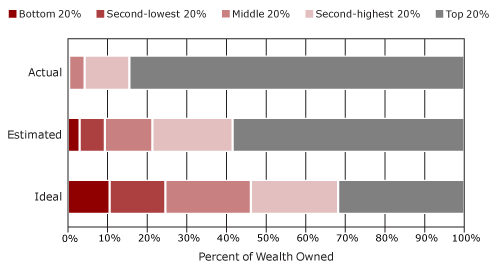
A remarkable study (Norton & Ariely, 2010) reveals that Americans have no idea that the wealth distribution (defined for them in terms of "net worth") is as concentrated as it is. When shown three pie charts representing possible wealth distributions, 90% or more of the 5,522 respondents -- whatever their gender, age, income level, or party affiliation -- thought that the American wealth distribution most resembled one in which the top 20% has about 60% of the wealth. In fact, of course, the top 20% control about 85% of the wealth (refer back to Table 1 and Figure 1 in this document for a more detailed breakdown of the numbers).
Even more striking, they did not come close on the amount of wealth held by the bottom 40% of the population. It's a number I haven't even mentioned so far, and it's shocking: the lowest two quintiles hold just 0.3% of the wealth in the United States. Most people in the survey guessed the figure to be between 8% and 10%, and two dozen academic economists got it wrong too, by guessing about 2% -- seven times too high. Those surveyed did have it about right for what the 20% in the middle have; it's at the top and the bottom that they don't have any idea of what's going on.
Americans from all walks of life were also united in their vision of what the "ideal" wealth distribution would be, which may come as an even bigger surprise than their shared misinformation on the actual wealth distribution. They said that the ideal wealth distribution would be one in which the top 20% owned between 30 and 40 percent of the privately held wealth, which is a far cry from the 85 percent that the top 20% actually own. They also said that the bottom 40% -- that's 120 million Americans -- should have between 25% and 30%, not the mere 8% to 10% they thought this group had, and far above the 0.3% they actually had. In fact, there's no country in the world that has a wealth distribution close to what Americans think is ideal when it comes to fairness. So maybe Americans are much more egalitarian than most of them realize about each other, at least in principle and before the rat race begins.
Figure 4, reproduced with permission from Norton & Ariely's article in Perspectives on Psychological Science, shows the actual wealth distribution, along with the survey respondents' estimated and ideal distributions, in graphic form.

Figure 4: The actual United States wealth distribution plotted against theestimated and ideal distributions.
Note: In the "Actual" line, the bottom two quintiles are not visible because the lowest quintile owns just 0.1% of all wealth, and the second-lowest quintile owns 0.2%.
Source: Norton & Ariely, 2010.

David Cay Johnston, a retired tax reporter for the New York Times, published an excellent summary of Norton & Ariely's findings (Johnston, 2010b; you can download the article from Johnston's Web site).

'via Blog this'

Thursday, October 6, 2011

Stand with the Oppressed Instead of Glorifying the Oppressors


Support the other 99%

Occupy Wall Street: STOP Police Brutality Against Peaceful Protestors


Stand with Occupy Wall Street
Not a single banker has gone to jail for crimes that led to the financial meltdown. But now over 1,000 protesters have been arrested in the inspiring Occupy Wall Street protest in New York City. Tell Mayor Bloomberg and Police Commissioner Kelly: Respect the Occupy Wall Street protesters' constitutional right to peaceful assembly.
MSNBC on NYPD Police Brutality during Occupy Wall Street Lawrence O'donnell (video)
An excellent piece of main stream coverage on this past weekend


MSNBC Article: 
Who is occupying Wall Street? Not just your average Joe

          
October 6, 2011

Huffington Post: Occupy Wall Street Mass Arrest Resembles Infamous, Costly Police Tactic, Critics Say


MassEquality Statement In Support of Occupy Boston

 BOSTON, October 6, 2011—The LGBT community is disproportionately represented among those who are victims of the nation’s ongoing economic crisis. We are the un- and underemployed. We are the un- and underinsured. We are the homeless and under-housed. And we are disproportionately impacted by government-sanctioned discrimination and denial of resources and protections.
If any group understands the plight of the 99% given voice by Occupy Boston, it’s the Commonwealth’s LGBT 6.5%

A protester holds a sign at the Occupy Wall Street protest last weekend
www.cnn.com
October 5, 2011
The 19-day-old Occupy Wall Street movement continues to gain momentum with the Left, as Democratic politicians, progressive groups and unions are joining the cause.  Members of the Service Employees International Union, the Communications Workers' union, the New York AFL-CIO and the United Federation of Teachers joined today's big march on Wall Street.

 "We're down with these protesters. We support the notion that rich folk are not paying their fair share," said Transport Workers Union President John Samuelsen. "Our bus operators are not going to be pressed into service to arrest protesters anywhere."


October 5, 2011

Occupy Wall Street Police Baton Attack Protesters 


(video)
Again.  NYPD white shirt attacks reporters and protestors by wildly swinging a baton. The officer has been identified by Anonymous as Lt. Brian Connolly.


www.digitaljournal.com
Occupy Wall Street has progressed from a small undistinguished movement to a front runner of national emerging protests within 19 days. This movement against corrupt corporations and Wall Street has quickly gained momentum within Middle America.


September 29, 2011


Thumbnail
Video of Police Using a Knee to the Throat of Protestor


September 25, 2011
Cops turn Violent, NYPD drag girl across the street (video)
September 24, 2011
PEACEFUL FEMALE PROTESTORS PENNED IN THE STREET AND MACED by NYPD Deputy Inspector Anthony Bologna (video)

Thumbnail


Video :  Arrested for yelling at a police officer.  For shooting video.  Dragged from behind the police line.  For standing in the street.

Thumbnail
 Video: This man was flipped over by his arm and twisted then arrested - for talking to an officer.

Financial Education: Helping You Help Others

NEFE’s Financial Workshop Kits


Helping You Help Others
This Web site was created to help you help others.
As a financial planning professional, social service expert, community volunteer and financial educator, one way you can help-is to provide assistance to your community on an ongoing, volunteer basis. You can help your community by helping those in need with their personal finances.
Sharing knowledge groups that have limited means—whether on your own, through public service agencies, or via charitable organizations—helps others learn to better manage their money and have the opportunity for a brighter future. And, you become a more integral part of the fabric of your neighborhood and community.
The National Endowment for Financial Education® (NEFE®) appreciates your dedication to your community and wants to make it easy for you to provide assistance to underserved groups on their financial well-being. To aid you, this Web site gives the materials to easily teach courses to a variety of groups.
For each audience, we provide a script/teaching plan with handouts, PowerPoint presentation, and related resources. All you need to do is download and print the materials and share your expertise and passion with others.


Downloadable Presentations

Financial Education with CashCourse - from the National Endowment for Financial Education

CashCourse.org -- National Endowment for Financial Education

What Is CashCourse?

CashCourse® provides financial education resources for colleges. It’s online, it’s free, it’s noncommercial, and it’s brought to you by The National Endowment for Financial Education® (NEFE®) – the only nonprofit foundation dedicated to improving the well-being of all Americans.


Benefits


CashCourse can help your students:
  • Build money management skills
  • Survive in a tough economy
  • Prepare for success!
 
Customizable Web site - provides easy access to financial resources for your students.
 
Low maintenance, high value, zero cost - CashCourse maintains the site content and provides templates for marketing materials.
 
Workshop Materials - Once your school enrolls with CashCourse, you will have additional teaching resources at your fingertips!

Tuesday, August 9, 2011

NPR: Tackling Obesity Amid Poverty In A Mississippi County : NPR

Tackling Obesity Amid Poverty In A Mississippi County : NPR
Valerie Moore's weight and poor  eating habits caught up with her two years ago, when she had a stroke at age 26.

This woman had a stroke when she was in her twenties and has since lost quite a lot of weight. She talked about how expensive fresh vegetables and fruit are, making the statement that if you have a low income those types of food are out of the range of your budget. She said (paraphrasing) that if you only have $5 and need a meal for you and your two kids for tonight, you can't choose the best food. In other words, the hamburgers on the dollar-menu are going to win out.

This is nothing new to me, having been a student for so many years, having been on a tight budget for all times, and before that living in a family which was poor. It often seems much, much too expensive to buy many tomatoes when they are over $3/pound, lettuce that is over $2, and when the cheapest fruit is $1/pound and only on-sale. I also have the ability to shop for sales and travel by private transportation to get these bargains, which many certainly do not. If you need to buy food close to home, you can count on almost double those prices, especially if you only live close enough to a "convenience" store. Broccoli is certainly very expensive and so is cauliflower. The woman interviewed said that buying a can of processed corn is affordable whereas 4 ears of corn are not.

What got me really thinking was when the older generation talks about how today's children are so out-of-touch with where their food comes from. I hear this a lot, and it sounds accusatory as if children willfully are just lazy and incurious:
"Every generation is getting weaker and wider," McLaurin says. McLaurin, 70, says his generation had to fish, hunt and work in the garden. "But now, children, that don't ring a bell with them."
This is where I think society shoulders the blame, not children. Our culture is so obsessed with making and spending money, and now views food as something to grab-and-go, a necessary but time-wasting activity. Witness how we treat the farmers in our country, forcing them to become mechanized assembly lines that produce food. Our society has cut out any emotion or love for the food and made it another form of commercialism. And, this is what we - as a culture - have passed onto today's children. That everything is a business and we are all cogs in the big machine.

What I think is the most important thing to comment on here is when the 70 year-old man said that children lose out because their lives are not are not like his was: his family had to hunt and fish and grow food. That is a loss -- one that I keenly and frequently experience -- feeling so cut-off from Nature. I recently moved to a new apartment (in a house) and just the fact that I have a 5-foot by 3-foot area of grass that I can walk barefoot in thrills me to no end.

What clicked in my mind was that I would be hard-pressed to tell you where one could hunt in my city or the immediate area. And, the actions one would have to go through to buy/own a gun makes that quite prohibitive.

One can fish -- with a purchased license -- if you can travel 4 miles away. Will the bus go to the ocean? Would anyone carry fishing poles and a bucket on the bus with their catch of the day? Can you bring dead animals on a bus?

In the apartment building I lived in, there was no grass on the property, let alone an area to grow a garden. Fortunately, I was financially able to move to this new place. One of the first things I did was plant a garden, after convincing the landlord to turn on the water faucet outside so I could water the plants. There is only room for 5 plants, but I am happy with that. I certainly could not live on the food from my garden.

So, it seems to be that this is the culture that our mechanized society has created for us to exist in. Is it any wonder we are divorced from our food?

Tuesday, April 6, 2010

Variables Predicting Happiness

From CGH Systems Book:

  •  Overall Ideas:  Positive Mental State: contentment, joy, overall satisfaction, positive mood, absence of negative mood, living according to true self (inner daemon).   Bliss, power, knowledge, optimism.  Feelings: self-esteem, hopefulness, capability, resilience/hardiness, decision-making ability, intrinsic motivation.   NOT: sex, age, having children, location, race, income (these can be controlled for). Except for when there is extreme financial hardship.
  • Predictors of Happiness: self-esteem, social support, efficacy, relatedness (feeling socially included), loving relationship with a spouse, personality traits such as extroversion and openness, community involvement, optimism, ack of neuroticism, spiritual or religious, autonomy, competence having goals and values, ability to adapt (change has a short impact), making progress, using effort, pursuing goals, lack of rumination, adequate resources, (Myers, 1992; Costa & McCrae, 1980; Heady & Wearing, 1992; Diener, Suh, Lucas, & Smith, 1999). Hardiness & Resiliency (Siebert, 1996)
  • Positive Mental Health: ego strength, intrnisic motivation, optimism (Antonovsky, 1993; Maddi, 1999a, 1996b).  Mental Health: feelings of vitality, subjective well-being, problem solving abilities, excercising control over environment and self, self-understanding and insight.  Jung variables: psychic ingeration, wholess, or sense of self.  Also, personality types. NF, SF, ST, NT types.  Maslow: Self-actualization.

Wednesday, March 31, 2010

News Analysis - With or Without Health Reform, We Pay for Others’

News Analysis - With or Without Health Reform, We Pay for Others’ Bad Habits - NYTimes.com:

"Unhealthy habits are one factor in disease, but so are social status, income, family dynamics, education and genetics. Patient noncompliance with medical recommendations undoubtedly contributes to poor health, but it is as much a function of poor communication, medication costs and side effects, cultural barriers and inadequate resources as it is of willful disregard of a doctor’s advice."

Punitive measures to force healthy behavior do not usually work. In 2006, West Virginia started rewarding Medicaid patients who signed a pledge to enroll in a wellness plan and to follow their doctors’ orders with special benefits, including unlimited prescription-drug coverage, programs to help them quit smoking and nutrition counseling. Those who did not sign up were enrolled in a more restrictive plan that, among other things, limited drug coverage to only four prescriptions a month.

The program, by many accounts, is failing. As of August 2009, only 15 percent of 160,000 eligible patients had signed up. Patients with limited transportation options were having a hard time committing to regular office visits. And experts say there is no evidence that restricting benefits for noncompliant patients has promoted healthy behaviors.

Healthy living should be encouraged, but punishing patients who make poor health choices clearly oversimplifies a very complex issue. We should be focusing on public health campaigns: encouraging exercise, smoking cessation and so on. Of course, this will require a change in how we live, how we plan our communities.

“It’s the context of people’s lives that determines their health,” said a World Health Organization report on health disparities. “So blaming individuals for poor health or crediting them for good health is inappropriate.”

Sunday, March 28, 2010

News from NASW: Diversity Education


Congressional Hearing about Educating Diverse Students


The House Education and Labor Subcommittee on Early Childhood, Elementary and Secondary Education held a hearing on March 18, 2010 titled “Elementary and Secondary Education Act Reauthorization: Addressing the Needs of Diverse Students” to examine how schools can appropriately educate low-income, minority, English Language Learners, disabled, Native American, and homeless students within the context of reauthorizing the Elementary and Secondary Education Act (ESEA), currently known as the No Child Left Behind Act.

This goal was expressed by Subcommittee Chairman Representative Dale Kildee (D-MI) in his opening statement: “While the No Child Left Behind Act shed light on the inequalities in our education system, it unfortunately did not do enough to close the achievement gap for diverse students…This must be a top priority for future steps in education reform.”

To this end, the Subcommittee considered recommendations from a panel of educators, advocates, and a researcher working to close the achievement gap for diverse students. They included Dr. Daniel Curry, Superintendent for the Lake Forest School District in Felton, Delaware, Dr. Jack Dale, Superintendent for Fairfax County Public Schools in Falls Church, Virginia, Arelis Diaz, Assistant Superintendent for Godwin Heights Public Schools in Wyoming, Michigan, Dr. David Gipp, President of United Tribes Technical College (UTTC), Jacqui Farmer Kearns, Principal Investigator for the National Alternate Assessment Center, and Michael Wotorson, Executive Director of Campaign for High School Equity.

To read the transcript go tohttp://edlabor.house.gov/hearings/ecese/Go here for more information on NASW’s advocacy efforts. Join the Advocacy Listserv to receive regular updatesNASW Standards for Social Work in Schools NASW Specialty Practice Section for School Social Work NASW School Social Specialist CredentialShareThisPosted in Legislative Update, act, children, education, house, schools, social work | No Comments »

Saturday, March 27, 2010

General Social Work Resources


social work - general

One Economy Corporation | One Economy
Gallup-Healthways Well-Being Index
Internet Social Worker | Welcome | Why do this tutorial?
The New Social Worker Online Blog
JOBS4social work
About.com Statistics help
Periodicals and E-Books Directory
Critical Social Work - Volume 1, No. 1
Feminist Theories & Social Work - EBSCOhost: Publications: 2514
Global Perspectives of Occupational Social Work - EBSCOhost: Publications: 251N
Homosexuality & Social Work. EBSCOhost: Publications: 252M
Human Sexuality, Ethnoculture & Social Work. EBSCOhost: Publications: 252P
Journal of Evidence-Based Social Work. EBSCOhost: Publications: 1GW8
Journal of Ethnic & Cultural Diversity in Social Work. EBSCOhost: Publications: 86M
Journal of Social Work Practice. EBSCOhost: Publications: 56H
Journal of Social Work Research & Evaluation. EBSCOhost: Publications: RIJ
IUC Journal of Social Work Theory and Practice
Principles of Social Work Practice. EBSCOhost: Publications: 253K
Research on Social Work Practice. EBSCOhost Electronic Journals Service
Can “Precious” be a Teaching Tool? | Social Workers Speak
Dogs Help Clients Express Themselves in Therapy | Social Workers Speak
NASW Practice Standards
NASW Lunchtime Series
NASW Practice section
NASW Code of Ethics (English and Spanish)
NASW Assurance Services - School Social Work Liability Insurance
NASW Social Work Career Center
NASW Student Center
NASW Studt Center for Press
NASW WebEd
NASW yearend2008report.pdf (application/pdf Object)
NASW Help Starts Here
NASW: Social Work Portal
National Association of Social Workers
National Association of Social Workers Massachusetts
National Universities Rankings - Best Colleges - Education - US News and World Report
Online Psychology Career Center
Personality test based on Jung - Myers-Briggs typology
Poor People's Economic Human Rights Campaign
Portal:Psychology - Wikipedia, the free encyclopedia
Psychology - Wikipedia, the free encyclopedia
Nonviolent Communication
social experiment - Google Search
Social Psychology Network
SOcial work theories - Google Book Search
Social Work--THE NEW SOCIAL WORKER Online--Magazine for Social Work Students and Recent
Society for the Study of Social Problems | Awards & Scholarships
Thomp College Success Links
The Social Welfare Spot
WE LEARN, Resource List, Subject List
The handbook of social psychology - Google Books
The Association for Transpersonal Psychology
Inquiring Minds
Andrew Hacker - Wikipedia, the free encyclopedia
Judith Katz - Google Search
Compassion: conceptualisations ... - Google Books
SW Licensing Exam prep - National Association of Social Workers Massachusetts
The Institute of Transpersonal Psychology | Graduate Education at the Frontier of Psychology and Spirituality since 1975
Reference, Facts, News - Free and Family-friendly Resources - Refdesk.com
SSC Style Guides and Writing Tools: Salem State College Library
SocialWorkBlog.org
Relationships and Compatablilty between Enneagram Types
Brian Bride — School of Social Work
Social Workers Speak
Women in the Literary Arts - Equality for Women
NASW WebEd
Community Tool Box - Solve a Problem
data drinking
Achieving Goals - Simple Tips for Achieving Goals
Transactional analysis - Wikipedia, the free encyclopedia
Amazon.com: Games People Play: The Basic Handbook of Transactional Analysis. (9780345410030): Eric Berne: Books
Out.com Exclusives | 80 American Classics
FreeMind - free mind mapping software
Goals—Goal-Setting and Reaching Goals
neuroeconomics - Google Search
Positive Psychology – Using Positive Psychology for Stress Management
Relax, Meditate - Elements of Nurture
Study Skills, Information Skills & How to Study Articles Mind Tools
TDC
Top 100 Open Courseware Projects | OEDb
Benefits of Smoking Cessation - Reviewing the Benefits of Smoking Cessation